
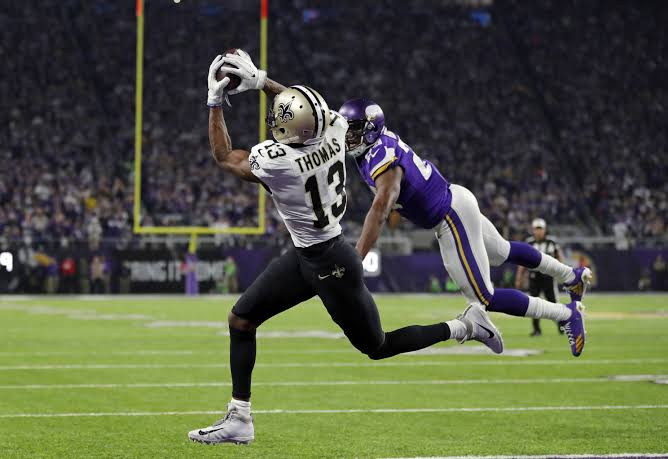
There is a certain type of sports fan who, when confronted with greatness they can't fully explain, invents a reason it doesn't matter. Michael Thomas — "Can't Guard Mike," Offensive Player of the Year, the man who shattered a record that had stood since 2002 — became the target of one of the laziest dismissals in recent NFL history. "Slant Boy," they called him. As if 149 catches in a single season were some kind of accounting trick. As if what Thomas did from 2016 to 2019 wasn't one of the most dominant stretches a wide receiver has ever put together in the modern NFL.
Let's settle this, once and for all.
The Numbers Were Absurd
Before we get to the narrative, the stats deserve a moment of silence.
In his first four NFL seasons, Thomas put up 92, 104, 125, and 149 receptions. His 196 catches in his first two years were the most in NFL history at that point. By the end of 2019, he was closing in on Randy Moss's record for receiving yards in the first four seasons of a career. He won Offensive Player of the Year. He set the all-time single-season reception record — breaking Marvin Harrison's mark of 143, which many thought was untouchable in the 16-game era.
In 2019, his catch rate was 80.5% on 185 targets. That is a number that almost doesn't make sense for a receiver getting double-teamed every Sunday. For context, that's territory you'd expect from a tight end running wheel routes in empty sets, not a 6'3" wide receiver operating as the focal point of every defensive game plan in the league.
And he did all of it against tight coverage. Per Next Gen Stats, during his record-breaking performance against the Titans in Week 16, Thomas averaged just 2.2 yards of separation and 4.3 yards of cushion — and still went for 12 catches and 136 yards. For the entire 2019 season, he averaged only 2.6 yards of separation. He wasn't getting open by blowing past cornerbacks. He was winning the possession game at the highest level possible, against defenders who knew exactly what was coming and still couldn't stop it.
The "Slant Boy" Myth, Dismantled
Here is what the Twitter crowd never bothered to look up: slant routes accounted for roughly 21% of Thomas's 2019 receptions. Just one-fifth. The rest of his route tree — outs, crossers, hitches, digs, seams, fades — made up the other 79%.
And if you think the slant percentage itself was unusual? DeAndre Hopkins, routinely ranked ahead of Thomas in those years, ran slants on about 20-26% of his receptions in 2018 and 2019 — often a higher share than Thomas. Nobody called him "Slant Boy." The nickname wasn't a scouting report. It was a dismissal.
NFL Next Gen Stats ran a comprehensive breakdown of Thomas across all eight standard routes in 2019. He ranked first in the NFL in four of the eight routes. His efficiency wasn't limited to one area of the field — he was the best or near the best at crossing routes, hitches, outs, and of course slants. On crossing routes, no wide receiver was pressed more at the line than Thomas — 49% of the time — and he still led the league with 29 crossing route targets for 382 yards.
Even when you strip out his slant production entirely, Thomas still led the NFL in receiving yards in 2019. Let that sink in. Remove his most criticized route, and he's still the best in the league.
He also led all wide receivers in receptions of 15 or more yards, ahead of receivers with far more claimed "separation" and "speed." He caught eight of nine targets on deep crosses for 232 yards. He caught all three of his corner route targets. The film and the data tell the same story: Thomas was elite across the entire route tree, not despite the slant, but in addition to it.
The slant was Thomas's most effective weapon because he was the best in the world at running it — not because it was the only tool in his shed. Masterful hitters don't get criticized for hitting the fastball.
A Hall of Fame Trajectory, Interrupted
By January 2020, Thomas was 26 years old. He had just won Offensive Player of the Year, shattered the reception record, and led his team to the NFC Championship game. The Saints had signed him to a massive contract extension because they knew what they had: a generational possession receiver who simply did not drop footballs. His playoff résumé was already stacking up — 31 receptions for 359 yards and 3 touchdowns in just five playoff games.
The reasonable projection for Michael Thomas at that moment was somewhere north of 10,000 career receiving yards, multiple more All-Pro seasons, and a serious conversation about Canton.
Then Week 1 of 2020 happened.
The Injury That Broke Everything
On September 13, 2020, the New Orleans Saints opened their season against Tom Brady's new Tampa Bay Buccaneers. The Saints won 34-23. It was a comfortable win — comfortable enough that Michael Thomas was still on the field in the fourth quarter of a game that was already decided, doing real-time work. That's when Alvin Kamara, his own teammate, rolled into Thomas near the goal line. Thomas's ankle buckled underneath him.
He walked off. He tried to play through it. He initially believed he could suit up the following week. The injury, however, was a high-ankle sprain — a notoriously slow and treacherous thing to heal — and it was worse than first reported. What followed was six missed games, an attempt to return that likely exacerbated the damage, and the beginning of the end.
The hardest part about that moment isn't the injury itself — those happen. It's that it happened late in a blowout, in the kind of situation where keeping your franchise receiver on the field is a coaching decision that can reasonably be questioned. High-ankle sprains in particular are not injuries you simply gut through. They compound. They come back. They affect your cuts, your plant foot, your release. Once the ankle was compromised, Thomas was never fully Thomas again.
He played only 7 games in 2020, 10 in 2021, 10 in 2022, and 13 in 2023 — each year a shadow of what the 2019 season had promised. The burst of a receiver who had averaged 2.6 yards of separation against the best secondaries in the NFL was gone. The body that had absorbed punishment and kept running for four straight elite seasons finally had a structural problem it couldn't outwork.
What We Lost
There is a version of Michael Thomas's career where that ankle never gets rolled up on — or where the Saints play it cautious with an 11-point lead in the fourth quarter and keep their best player on the sideline. In that version, Thomas is probably at 12,000+ receiving yards by now, with three or four more Pro Bowls, and a legitimate Hall of Fame case that no one debates.
Instead, we got 565 career catches and 6,569 yards — a genuinely excellent career, but one that reads more like a promising career that got cut short than the monument it should have been. He had 470 of those catches in just his first four seasons. The math tells the story of what was lost.
The "Slant Boy" nickname wasn't just lazy — it was a convenient excuse not to acknowledge what Thomas actually was during his peak. An 80.5% catch rate on 185 targets. First in the league on four separate routes. The record books can't be argued with.
Michael Thomas was elite. The ankle injury was preventable — or at least, the conditions that led to it were a choice. And an entire generation of social media hot takes spent his career manufacturing reasons not to respect him, rather than watching what was actually happening on the field.
You couldn't guard Mike.
They still can't explain him.