
There is a version of this debate where Tom Brady wins by default because he has seven Super Bowl rings and Drew Brees has one. That version of the debate is lazy. Rings are a team accomplishment. Quarterbacks don't win Super Bowls — franchises do. And if we're evaluating individual greatness, the numbers, the head-to-head record, and the context in which both players performed tell a much more complicated story. One that is very flattering to the man from Austin, Texas, who spent 15 seasons dragging historically bad defenses to the playoffs. The Patriots once had three Hall of Famers on defense at the same time. The Saints once had a "defense" in the same sense that Switzerland has a navy — technically, it exists.
Head to Head: The Record Let's start with the most direct measure of quarterback competition: when the two faced each other, who won? Over the course of their careers, Brees and Brady met eight times. Brees won five of those eight games. The only quarterback in history with more Super Bowl rings than Brees lost to him more often than he beat him. That is not noise — that is a pattern.
2002 — Saints 21, Patriots 14. The first meeting. Brady was coming off his first Super Bowl win. Brees was starting just his fifth career game. Brees: 10 for 18, 104 yards, 1 TD. Brady: 36 for 53, 353 yards, 2 TD, 2 INT. Brees won despite throwing fewer passes than Brady had incompletions. 2005 — Saints 41, Patriots 17. Brees went 19 for 24, 248 yards, 2 TDs. The Chargers shut out the Patriots 24-0 in the second half. Brady had three Super Bowl rings at this point. Didn't matter. 2009 — Saints 38, Patriots 17. Brees posted a perfect 158.3 passer rating — the only one of his career. He went 18 for 23, 371 yards, and 5 touchdowns. Brady threw 2 interceptions and 0 touchdowns. The Saints were 10-0 at the time and on their Super Bowl run. Brady had no answers. 2013 — Patriots 30, Saints 27. Brady gets one back with a game-winning touchdown pass to Kenbrell Thompkins with five seconds left. The Saints came in 5-0. Brady: 25 for 43, 269 yards, 1 TD, 1 INT. A gutsy win, and Brady earned it. 2017 — Patriots 36, Saints 20. Brady's best performance of the series. He threw for 447 yards on 30 of 39 passing with 3 touchdowns. Brady wins that one cleanly, no asterisks needed. 2020, Week 1 — Saints 34, Buccaneers 23. Brady's debut in Tampa Bay. Brady threw 2 interceptions. Alvin Kamara scored twice in 90 seconds off a pick-six by Janoris Jenkins. Welcome to the NFC, Tom. 2020, Week 9 — Saints 38, Buccaneers 3. One of the most lopsided results in Brady's career. Brees went 26 for 32, 4 touchdowns. Brady threw 3 interceptions and was held scoreless until garbage time. The Saints completed a dominant regular season sweep. 2021 NFC Divisional Playoffs — Buccaneers 30, Saints 20. Brees threw 3 interceptions and the Bucs converted the turnovers into touchdowns. Brady played a clean game — 18 for 33, 199 yards, 2 TDs, 0 INTs. Brady won this one the right way.
Final series: Brees 5, Brady 3. The 2020 regular season is particularly damning for the Brady mythology. In Brady's first year in Tampa Bay — with Gronkowski, Mike Evans, Chris Godwin, and Leonard Fournette — Brees beat him twice, including a 35-point beatdown in Week 9. Brady won the playoff rematch, which was decided almost entirely by turnovers, and it stands as the only game in the series where Brees demonstrably beat himself.
What Brady's Record Against Brees Tells Us
Brady's supporters love to point to his head-to-head record against other legends. He finished 11-6 against Peyton Manning overall and 3-1 against Aaron Rodgers. Those are dominant numbers. So why did Brees — with fewer weapons, worse defenses, and more pressure on his offense than almost any quarterback in modern history — beat Brady more consistently than any other elite QB of their era? Manning's teams were routinely in the top half of the league defensively. The Colts had Bob Sanders and Dwight Freeney. The Broncos had Von Miller and the best defense in football in 2015. Manning had real help. Rodgers had top-ten defenses during his prime years in Green Bay. What did Brees have? In 2012, the Saints were tracking toward the worst yardage-allowed mark in NFL history through the first four weeks of the season — averaging 7.1 yards per play. In 2014 and 2015, Football Outsiders ranked New Orleans dead last in defensive efficiency two years in a row. The 2015 Saints were allowing 7.7 yards per pass attempt — a league-high — and opposing quarterbacks posted a 24-to-4 touchdown-to-interception ratio against the New Orleans defense that year. The only team to perform similarly badly in that metric in recent history? The 2012 Saints. They were essentially competing with themselves for the title of worst defense in modern NFL history, and Brees was still winning division titles. Manning and Rodgers had the luxury of a lost game being just a lost game. When Brees' defense gave up 35 points, he had to score 38 to win. He did it often enough to make the playoffs nine times in 15 seasons.
The Receiver Argument Brady Fans Refuse to Make Fairly
Brady played with Randy Moss, Wes Welker, Rob Gronkowski, Antonio Brown, Julian Edelman, and Mike Evans. Brady's receiving corps collectively earned over 13 Pro Bowl selections during his career. Gronkowski alone accounted for five of them and produced over 7,500 yards and 77 touchdowns as Brady's primary weapon. Gronk's production alone — 11% of Brady's career yards and over 15% of his touchdowns — would represent the best receiver most quarterbacks ever played with. Brees' Saints wide receivers earned three Pro Bowl appearances during his entire tenure — all of them belonging to Michael Thomas, who made it in 2017, 2018, and 2019. Three Pro Bowls. From one guy. In 15 seasons. And Thomas didn't even arrive until 2016, Brees' tenth year with the Saints. For the first decade, Brees' best weapon was Marques Colston — a seventh-round pick who somehow never made a Pro Bowl despite posting 9,759 career receiving yards and 72 touchdowns. Colston was quietly one of the most productive receivers of his era, and the voters simply never noticed, in part because he was catching passes from Brees instead of from a quarterback surrounded by more media buzz. Before Thomas arrived, Brees was distributing the ball to Willie Snead, Lance Moore, Robert Meachem, and Devery Henderson. These are not names that inspire fear in defensive coordinators. These are names that inspire a concerned nod and a change of subject. Despite this, Brees finished with a career completion percentage of 67.7% — second all-time at retirement — compared to Brady's 64.3%. Brees also led the NFL in passing yards seven times, a record. He accomplished all of this passing to players that most ESPN anchors couldn't reliably identify in a lineup. Marques Colston had more Pro Bowl-caliber seasons than Pro Bowl appearances, which says everything you need to know about both his talent and the Saints' reputation outside of Louisiana.
Super Bowls Are a Team Sport
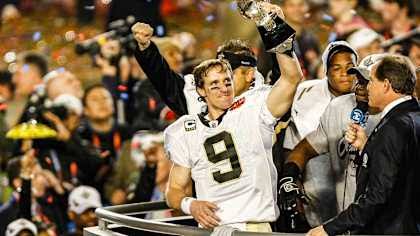
Seven Super Bowls is an extraordinary achievement and no one is taking it from Brady. But attributing seven rings entirely to the quarterback is like crediting a chef for a restaurant's plumbing. Brady won three of those championships with a defense so dominant it is now studied in coaching clinics. The 2003 and 2004 Patriots had arguably the best secondary in football. The 2018 Patriots beat the Rams in the lowest-scoring Super Bowl in history — almost entirely on the back of a defense that held Los Angeles to three points. Brady threw for 262 yards and zero touchdowns in that game and still got a ring. Good for him. But that's not a quarterback performance — that's a very competent passenger on a very good flight. When Brady left New England for Tampa Bay, he didn't arrive as a lone savior. He joined a team with Chris Godwin, Mike Evans, Leonard Fournette, Rob Gronkowski (who came out of retirement specifically to play with Brady), and one of the better defenses in the NFC. The Buccaneers were a legitimate playoff contender before Brady arrived. Brady elevated them to a championship. That is an impressive accomplishment — but it is a different thing from what Brees did repeatedly: carrying an offensively elite, defensively catastrophic team to the postseason with wide receivers nobody outside New Orleans had ever heard of. The 2009 Saints, Brees' Super Bowl team, were carried almost entirely by the offense. Their defense finished 25th in points allowed that season. They gave up 45 points to the Vikings in the NFC Championship Game and still won in overtime. Brees then went out and was named Super Bowl MVP, completing 32 of 39 passes for 288 yards and 2 touchdowns in a 31-17 win over the Indianapolis Colts. He was the best player in the building on the biggest stage of his career, with a defense that spent four months actively trying to sabotage him.
The Analytical Verdict
When you strip away the roster advantages, the defensive infrastructure, and the organizational stability Brady benefited from in New England, you are left with the actual quarterback evaluation: who was more skilled at playing the position? The head-to-head record says Brees, 5-3. The accuracy numbers say Brees. The performance-in-context argument — what each player did relative to the tools available to him — says Brees by a considerable margin. Tom Brady is the greatest winner in NFL history. But Drew Brees — the first-ballot Hall of Famer who spent 15 years performing miracles for a franchise with historically bad defenses and a receiving corps composed mostly of career backups — may well have been the better quarterback. Those are two different things, and conflating them is what keeps this debate alive longer than it probably should. Bottom line: Brees went 5-3 head to head against the man with seven rings. His only Pro Bowl wide receiver for the first decade of his Saints career was a guy who never made a Pro Bowl. Michael Thomas made three Pro Bowls, but didn't show up until Brees had already been dismantling defenses with Lance Moore for ten years. His defenses were historically, repeatedly, almost impressively terrible. He led the league in passing yards a record seven times. He did all of it in one of the most demanding offensive environments a modern quarterback has ever been asked to operate in. The individual case isn't close. Seven rings just make a lot of noise, and most people mistake noise for proof.