
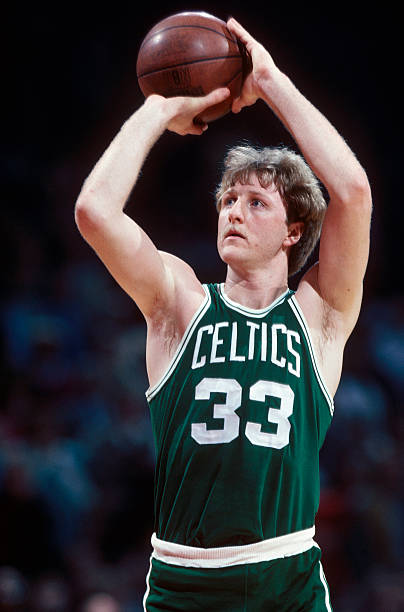
Larry Bird was a genius. An absolute, unimpeachable basketball genius. He was a three-time MVP, a three-time champion, a man whose basketball IQ was so high that opponents feared him even when he was standing still. His feel for the game, his clutch shooting, his passing — these were gifts that transcended eras. No one serious is disputing any of that.
But genius, it turns out, has to share the floor with bodies. And the bodies in today's NBA would give Bird a problem he never had to face at his peak: an entirely different category of human athlete.
This isn't a hot take dressed up as analysis. This is what the data from sports science, Olympic track records, and decades of athletic progression actually shows. The human athlete of 2026 is measurably, objectively faster, stronger, and more physically capable than the athlete of 1985. And in a sport as intimate and explosive as basketball, that gap matters enormously.
The Olympics Don't Lie
The most honest sport in the world is the 100-meter dash. There is no scheme, no system, no team chemistry. You run from point A to point B as fast as your body will allow. The clock doesn't care about your heart, your legacy, or your narrative.
Here is what the world's fastest men looked like during Larry Bird's career. At the 1980 Moscow Olympics, Great Britain's Allan Wells won gold in 10.25 seconds. At the 1984 Los Angeles Games — Bird's prime, the year he won his first MVP — Carl Lewis took gold in 9.99 seconds. By 1988, when Bird was still an All-NBA First Team player, Lewis won again with 9.92. These were the peak human specimens of Bird's era, the absolute best the world had to offer on the track.
Now look at the 2024 Paris Olympics — the most recent Games. In the men's 100-meter final, all eight finalists ran under 9.91 seconds. Every single man in that race was faster than the Olympic gold medalist from Bird's prime. The winner, Noah Lyles, ran 9.79. Sixth-place finisher Letsile Tebogo ran 9.86 — a time that would have won silver at every Olympic Games during Bird's entire NBA career. The man who finished dead last in Paris would have been the fastest human being on earth for most of the 1980s.
That improvement happened in roughly 40 years. One human lifetime. These aren't different species — they're the same Homo sapiens, eating better, training smarter, coached with precision tools that didn't exist in 1984, selected from a global talent pool that has grown enormously. And the athletes who now occupy NBA rosters went through that same evolutionary process.
Baseball Proved It, Too
If you want a second data point — one closer to Bird's career timeline — look at Major League Baseball. Pitching speed is one of the cleanest measures of raw athleticism in team sports. It is almost entirely about arm strength, mechanics, and explosive muscle recruitment.
During Bird's playing years, radar evidence puts the average major league fastball at around 88-89 mph. A pitcher touching 90 was considered a genuine flamethrower. Books and scouting reports from the 1970s and '80s describe mid-80s velocity as entirely sufficient for a big-league career. That was the baseline.
By 2026, the average four-seam fastball has already hit 94.7 mph on the season — and analysts expect it to climb further before September, potentially making this the fastest fastball season in recorded history. The average pitch that would have made a pitcher elite in Bird's era is now below the threshold for keeping a roster spot. In Bird's day, relievers who sat at 85 mph held down MLB jobs. Today, a reliever averaging 88 mph is fighting for his career. The top reliever in baseball this season, Mason Miller of the Padres, averages 101.2 mph — a number that would have seemed physically impossible to the scouts of the 1980s.
That's not a handful of genetic freaks pulling numbers upward. That's the entire population of professional baseball players having shifted. Apply that same curve to basketball. The players who were too slow, too ordinary athletically, to make an NBA team in 2026 would have been legitimate rotation players in 1985. The floor moved.
What This Means on the Floor for Larry Bird
Here is what Bird was: a 6'9", 220-pound small forward with an elite shooting touch, elite basketball intelligence, elite vision, and by the admission of nearly everyone who watched him, below-average foot speed for a player at his position. Even Bird's most ardent admirers acknowledged that he compensated for his lack of athleticism with anticipation, positioning, and skill. Pat Riley — who coached against Bird in three NBA Finals — noted that while Bird was relatively slow, he had an uncanny ability to read plays before they developed.
That was workable in the 1980s, when the game was slower, the rules permitted more physical contact that naturally compressed speed differentials, and the average opposing forward was built along similar lines. The league's athletes were exceptional for their time, but they were not the athletes of 2026.
In today's NBA, Bird would step onto the floor and immediately face wing defenders who combine his size with a completely different level of quickness. The modern small forward is built on the same athletic progression those Olympic sprint times represent — players who can switch onto guards, close out on three-point shooters in a single explosive step, and run the floor in transition at speeds the 1980s game simply didn't produce. These are players developed from childhood under data-driven training, sleep science, and biomechanical optimization that didn't exist in Bird's era.
Bird's greatest strength was finding space through anticipation and positioning. But the defensive schemes of 2026 — built around switching, help rotations, and athletic versatility — are specifically engineered to eliminate those gaps. The league moved this direction precisely because the athletes got good enough to execute it. In Bird's era, that kind of sustained defensive complexity was largely impossible because the players weren't quick enough in recovery to maintain it. The schemes caught up to the athletes, and the athletes kept improving.
The Pace Problem
The modern NBA runs at a pace that would have been almost unrecognizable to the league of the 1980s. More possessions, more transition, more ground covered per game — the physical demands of the contemporary game are categorically different. Bird's genius at slowing things down, at controlling tempo, at winning through poise and positioning — those skills are real. But the game has been redesigned around the very athletic advantages Bird lacked. You cannot impose a slower tempo on a defense capable of running you off the ball on every catch.
The Honest Caveat
None of this means Bird would be a bad player. A man with his shooting ability, court vision, and competitive intelligence would find a way to contribute in any era. Many believe that if Bird had been raised in today's training environment, he might have developed athleticism that his 1980s development program never unlocked. Coaches throughout history have found roles for players whose minds exceeded their bodies.
But "he would have adapted and been good" is not the same as "he would have dominated the way he dominated in his time." The case being made here is not that Bird was overrated — it is almost the opposite. What he achieved, given the tools available to him and the game as it existed, makes his legacy even more remarkable. He maxed out his era completely.
The problem is that the era changed.
Human athletic evolution in sport is real, documented, and relentless. The Olympics prove it every four years in an event where no one can argue about context or conditions. During Bird's entire career, the Olympic 100-meter gold was won in times that today wouldn't survive the semifinals. Baseball proves it every time a reliever sits at 98 mph in the seventh inning of a Tuesday game in April — a velocity that in the 1980s would have made a pitcher legendary. And basketball proves it every night in 2026, in the form of wings and forwards who run like guards, defend like specialists, and shoot like Bird himself.
Larry Bird was a basketball genius. But genius, in the modern NBA, needs to fit inside a body built for 2026. And on that front, the world moved on without him.